Blog

What’s in the Name? - A few words on chanting or kirtan by Nina Rao

The practice of chanting, or kirtan, is an exploration into understanding the answer to that very question. 

Chanting and repetition of the Divine Name has been my practice and life Path since 1996, but as I trace this path back, I see where there have been signs pointing me in this direction earlier on…

How did I start?:

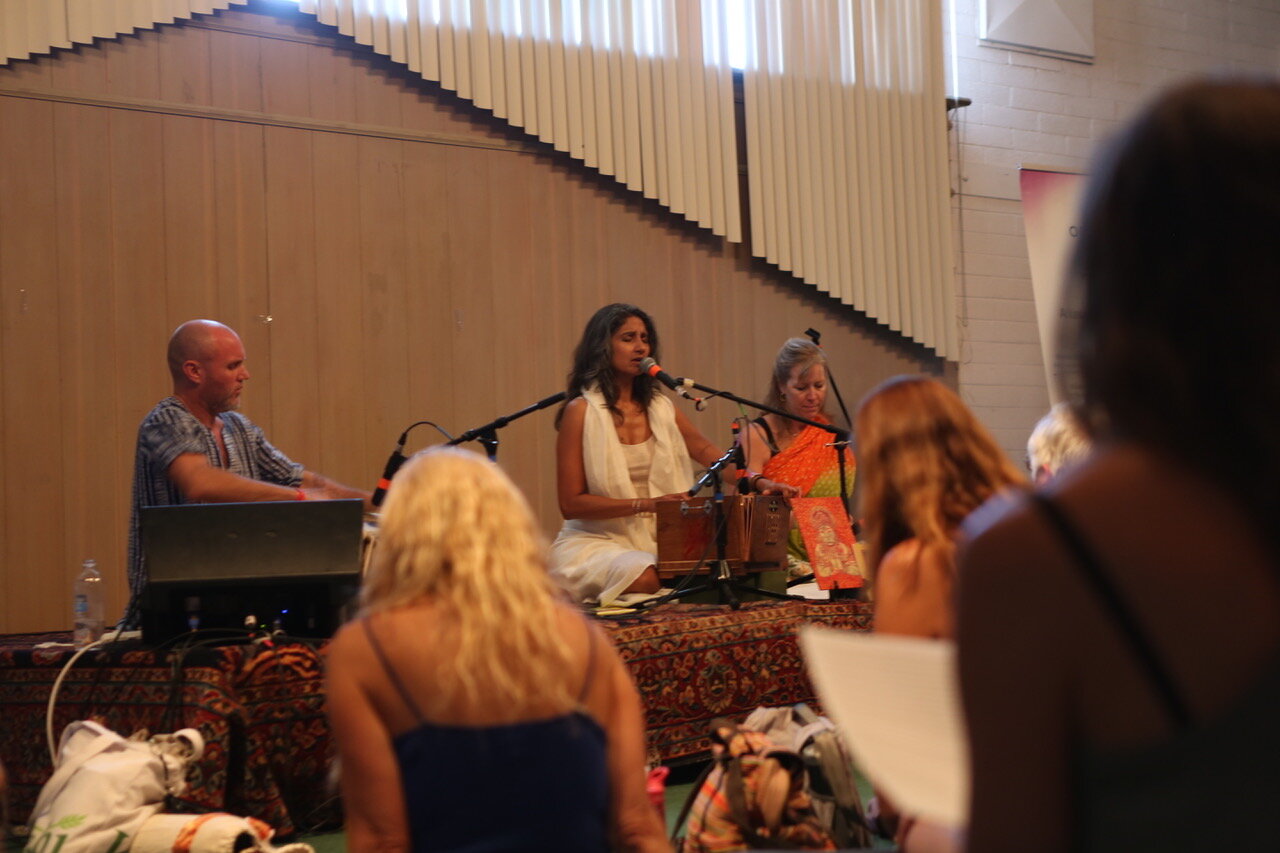
My first experience of kirtan, a form of call-and-response musical chanting, pronounced keer (sounds like peer) – thun (sounds like the first syllable of thun-der), was as a girl of 9 years on a summer vacation in my grandfather’s home in the south-western Indian coastal village of Bekal. It happened very naturally around my grandfather’s harmonium (a wind pumped reed organ). The family would gather around and follow his instructions by singing back the line that he chanted in response. My aunts, my mother, and cousins seemed to know this practice, and though my sisters and I didn’t know the meaning of the words we were singing, we quickly caught on. That night, there was a gathering for the whole village where others from the community ranging in age from young kids to elders took turns leading the chants and everyone responded. It was a harmonious uplifting moment with everyone turned toward the altar in one sacred intention. 

We never talked about that evening after I returned to my home abroad, but the deep and expansive feeling that came over me that night stayed quietly with me. Unexpectedly, it was re-awakened 23 years later at a retreat center in the Catskills in New York when I went to my first yoga retreat and heard Krishna Das sing Sri Ram Jai Ram Jai Jai Ram. It was immediately clear that I wanted to be in that deep space as much as possible, and chanting became my core sādhana, or spiritual practice. All I knew then was that the chanting had resonated so strongly that it shook my very core. What I know now is that this practice has given me an unshakeable focus, has helped me live my life in a good way, and has become my refuge. 

My guru, Sri Siddhi Ma, encouraged me to take everything with me into the practice and bring it to the feet of That which surpasses understanding; That which is unseen, and That with which we seek union.  

Why Chant?:

The sacred texts say that chanting cleans the mirror of our hearts to clearly reflect our True Nature, and further that this True Nature is Love and Joy. The Names have the power to dissolve our sense of separateness so we can really understand the interconnectedness of All. We have so much emotional and psychological stuff that we are working through, we need help finding clarity, and with practice we can find a softening around the hard edges of life. On the path to realizing who we truly are, it may seem there is no end in sight, but along the way it’s possible to sit a bit more comfortably in ourselves. We may find we have a growing awareness, a little more peace of mind, courage and strength to accept all that life brings, kindness and compassion for others and ourselves, and connection to and trust in our own hearts. 
Addressing a group of school students, His Holiness the Dalai Lama said that the best spiritual goal they could strive for would be to be the best Friend possible to everyone. Seems simple, but we all know how challenging that is - this is a challenge I accept. To meet this challenge, the chanting of the Name, which I see as a form of prayer, is where I can ask for help, I can cry, I can complain, I can give thanks, I can just Be. 

The Power of the Lord’s Name – 
What could not be understood in any other way
Can be grasped by uttering the Lord’s Name,
What was invisible before
Will become visible by uttering the Name,
What was unutterable before
Will find expression on repeating the Name,
And the One who could not be found before
Will himself come to meet you on repeating the Name.
What was impossible to obtain
Can be obtained in plenty now
Through ceaseless repetition of the Name.
Human beings are completely caught
In the web of attachments, declares Tuka,
But they will be saved through repetition of the Name.
(Gatha 3047) - Tukaram

What are the roots of kirtan?:

This practice of kirtan, or nāma sankīrtan (chanting the Name in a group), is a fundamental practice of bhakti yoga as it includes keeping company of like-minded seekers (satsang or sangha) and singing the Divine Names.

Some scholars tracing the history of this oral tradition of kirtan, in India, say that it emerged as a popular spiritual practice during the bhakti (devotional path) movement that began as early as the 7th century and flourished across the country, assuming regional forms between the 12th and 17th centuries. Many of the chants practiced today are inspired by the compositions of poets-musician-saints to name a few: Adi Shankaracharya (9th century); Namdev, Jnaneshwar (13th century); Mirabai, Chaitanya Mahaprabhu, Purandaradas, Surdas (16th century); Tukaram, Samarth Ramdas (17th century), and so on. Some of the mantras in these chants were revealed as early as in Vedas. 

In the days past, at sunrise or sunset, men and women from all walks of life sat together, opening their hearts to sing the Name of God. The very syllables that they sang invoked the singers’ deeply held virtues. To this day we see these purifying practices in temples, ashrams, and sacred places everywhere in India.

It is possible that the practice of kirtan made its way to this hemisphere on the heels of eastern philosophies brought to the west in the late 1800’s. This was continued by other spiritual and yoga teachers who came to America between the 1920s-1960s, and followed by Western seekers (including the Beatles) who travelled to India in the 1960s-1970s who brought back what they had learned. Chanting as a practice was more widely experienced with the growth of yoga and meditation in different lineages through the 1990s to the present day.

It’s now quite common to find local chanters leading kirtan in many yoga studios across the US. Often yoga teachers will play the music of the many recordings of western chanters proliferating the new age music category. From the time I met Krishna Das  and he had released his first album in 1994, I have witnessed the size of kirtan gatherings grow from a handful of people in a small yoga studio to thousands in large concert halls and outdoor festivals around the world. Now kirtan albums are even nominated for Grammys!

How Do We Chant?:

But, you don’t have to know any of this. You don’t have to belong to any lineage to practice this tradition of chanting, nor do you need to train or prepare to start. Singing is a natural part of our humanity. Physically, singing is satisfying in ways nothing else can quite duplicate--breathing deeply, generating sound and vibrations within one’s own body, blending one’s own voice with those of others and musical instruments is satisfying in and of itself.

If you are new to kirtan, all that’s required is the intention to dedicate yourself to the practice for time that you might attend a kirtan gathering. Just know that all you have to do during that time is to allow the thoughts to come and go. Don’t cling to any thoughts, and try not to solve any problems, or complete the task lists in your mind. Try not to evaluate your state of mind or any feelings that may come up. Just focus on the sound of the Name, listen to the caller, and respond as fully as you can in your voice. Each time you realize you’ve been pulled away by a thought, let go of any judgement you may have, begin again, repeat the Name. We all do this many times over each time we chant, but the more we practice the more we can give ourselves to the practice. 

The power of chanting infuses your being whether you are completely immersed or skimming the surface, but the important thing is the act of doing the practice.

We are calling out from our deepest hearts, which is the very same place that we are receiving the wisdom and blessings in response.

The nature of chanting is repetition, so if we stay with it and try to move past the boredom we can deepen our experience and be more in the moment. In this moment, now, there is freedom - freedom from the obscurations of anger, fear, jealousy, and any feeling that closes the heart down. 

A moment is eternal, a moment is not in space or time. When we dive into the moment, there is Presence … Loving Awareness  – Ram Dass 

Music and Meaning of the Chants:

Indian chants are rooted in the classical Indian system of rāgas, that which colors the heart, in which a series of notes are grouped together in characteristic patterns intended to evoke specific spiritual qualities or states of being. As the chants have found their voice in the West, the melodies have naturally been westernized and so has the instrumentation, but the power of the mantras remain.

[I should mention here that there are two other equally common personal practices of mantra repetition: (1) chanting/repetition without melody/music slightly under the breath as if murmuring, often counting on a string of beads or mala - this practice is japa. (2) of writing mantras repeatedly as a practice - likhita japa.]

Chant melodies are very compact, usually consisting of only one or two phrase groups which are repeated over and over again. This repetition breaks the normal linear structure we might be used to in conventional music.

It helps to start with an attitude of surrender to the practice that you will be doing. Let it do its thing and know that there’s no downside to these Names.

The music prepares us by evoking in us the appropriate devotional mood and, of course, it carries the sound of the mantras to us. It is the mantras themselves that are both means and ends. 

There are thousands of Divine Names. You can tune-in in as many ways, but they are all aspects of and describing the One blessed in-dwelling Presence of which we are all a part.

The teachings tell us that The Name and Named are one. The Divine Reality manifests as sound or word and is the mystical bridge between finite and infinite; the direct link between the individual soul with the universal soul.

Many people ask about the meanings of the Names. We can certainly learn from the sacred texts about Sīta and Rām, the divine beings of the Ramāyana; Krishna, the dark-skinned Lord of the Mahabhārata and Bhagavad Gita; Goddess Kāli/Durga, the Slayer of the demon Mahishāsura from the Devi Bhāgavatam; Shiva from the Puranas, and so on. The Seers say these Names are the Names of our own Selves, and the deepest meaning can only be realized within our own heart-minds. 

After a while, it is almost as if the chant begins to sing us, rather than the other way around.

Ram’s form left this world, Krishna’s form left this world but the Name stays. By reciting the Name everything is achieved, everything. – Neem Karoli Baba 

Nuts and Bolts:

The Divine Name can be chanted on its own, such as Rām, or be part of a longer mantra (sacred utterance) phrase. 

According to Edwin F. Bryant, the popular etymology of mantra (pronounced mun, rhyming with sun) – tra is “that which frees the mind”. Here the first syllable man means “mind” and in Sanskrit tra added means instrument of (as in instrument to free the mind).

An example of a mantra is: Srī Rām Jai Rām Jai Jai Rām.

In this mantra, Rām is the Divine Presence, and Srī is a term of reverence. Jai means Hail or Victory or Glory to.

Examples of commonly chanted devotional/bhakti mantras:

Om
Govinda Jaya Jaya Gopāla Jaya Jaya
Hare Krishna Hare Krishna Krishna Krishna Hare | Hare Rām Hare Rām Rām Rām Hare
Hari Bol
Jai Mā
Jaya Jagatambe He Mā Durga
Om Aim Saraswatye Namah
Om Gam Ganapatāye Namah
Om Mātā Kāli
Om Namah Shivāyah
Om Namo Bhagavate Vāsudevāyah
Om Namo Narayanāya
Om Shrī Mātre Namah
Rādhe Govinda
Rādhe Shyām
Sīta Rām
Srī Rām Jai Rām Jai Jai Rām

Intention is the most important thing. Do your best to pronounce these Names as close to their original pronunciation in the Indian language. Don’t worry, it’s not terrible if you don’t get it exactly right. 

These mantras can be chanted in a great variety of melodies of which there are numerous recordings that can be found online and on CDs.

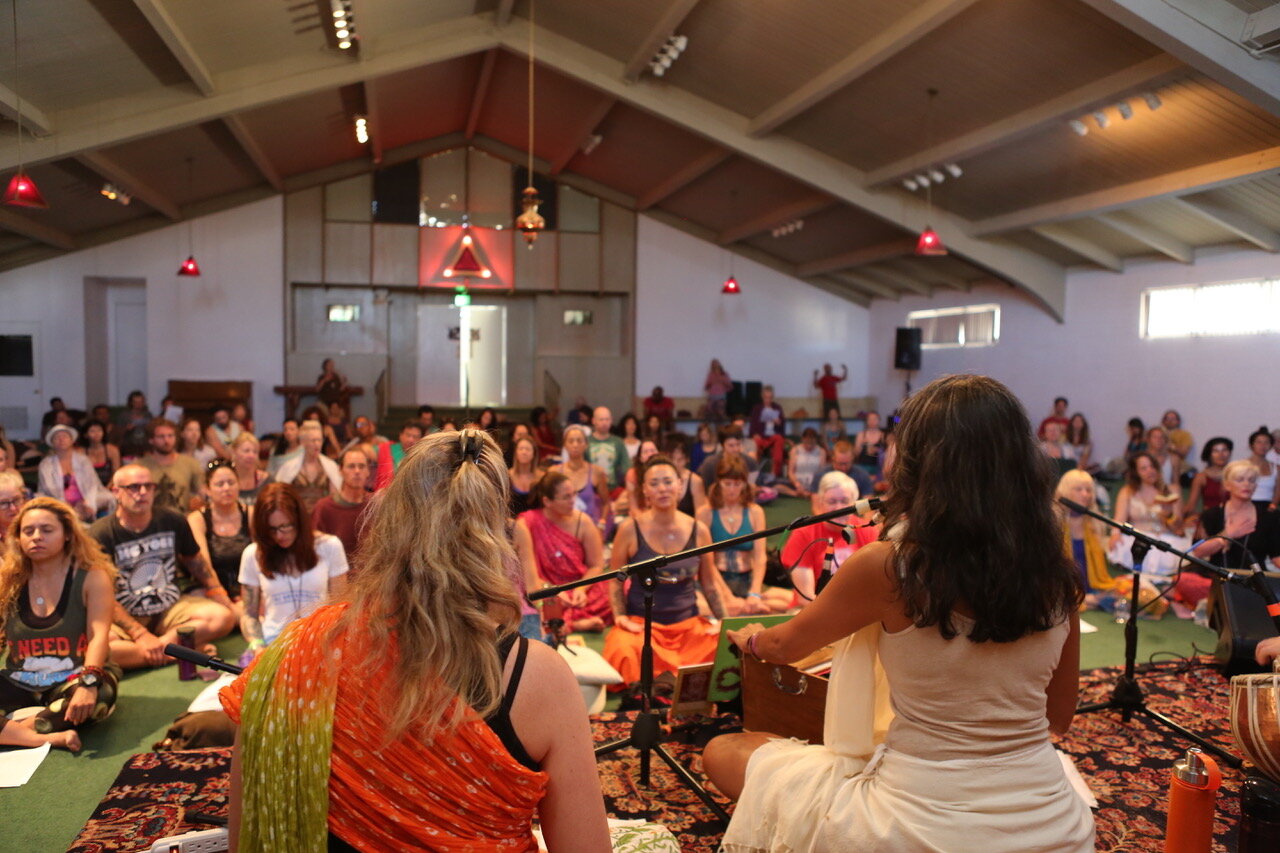
Generally, in temples and ashrams, everyone will be facing the altar and chanting, including the leader. In some places where there is not a formal altar, the leader and musicians face the gathering.  

List of Basic instruments:

- Voice of leader and voices of responders
- Harmonium or drone string ektara
- Drum: two-headed dholak, khol, or tabla
- Finger cymbals (kartals or manjīra) or tambourine or shakers
- often included in India is bamboo flute (bansuri) and in the west often guitar, violin, cello, djembe or frame drum
- Hands for clapping!

Sometimes the only music made is the voices of the chanters accompanied by clapping! Nothing else is needed. In some groups the chanting is done at a slow steady pace for the whole practice. Another common form of chanting is to start slow, at low pitch and gradually build to a faster tempo and higher pitch as the energy is heightened. It is recommended to take a short period of silence and allow the meditation to occur after the chanting. 

Some Other Mantras:
Chanting of the Divine Names as described above can be practiced by anyone. There are no harmful effects in anyway, only the upside of doing practice.

 As you deepen your practice and reading you may come across the chanting of different mantras such as:

 - seed or bīj mantras for a chakra or deity as a specific meditation|
- mantras to wish peace to all beings (Om Lokāh Samastah Sukhino Bhavantu or Om Shāntih Shāntih Shāntih)
- mantras for physical health and wellbeing
- mantras for gratitude for receiving food
- longer mantras of a few phrases such as like the ancient Gayatri Mantra from the Rig Veda
- Devotional Hymns such as the Hanuman Chalisa
- Mantras for protection and safety such as Maha Mrityunjaya Mantra (from the Puranas)
- Mantras from philosophical texts called the Upanishads
- stotras such as Vishnu or Lalita Sahasranama (thousand Names)

Commonly practiced in the U.S. are also the Kundalini or Sikh chants such as Sat Nām, Wāhe Guru, Ong Namo Guru Dev Namo) and Buddhist chants such as Om Māne Pedme Hung and Om Tāre Tuttāre Ture Soha.

So, we’ve now stepped onto the Path of chanting with a glimmer of hope that it may help us. Over time the chants begin to transform us from inside, and as we surrender more and more to the practice, the wisdom of our own Hearts is gradually revealed.

Chanting is a mysteriously powerful practice and can’t be understood by explanation. We learn about chanting by chanting.

Sarva Mangalam (Auspiciousness and Happiness for All)

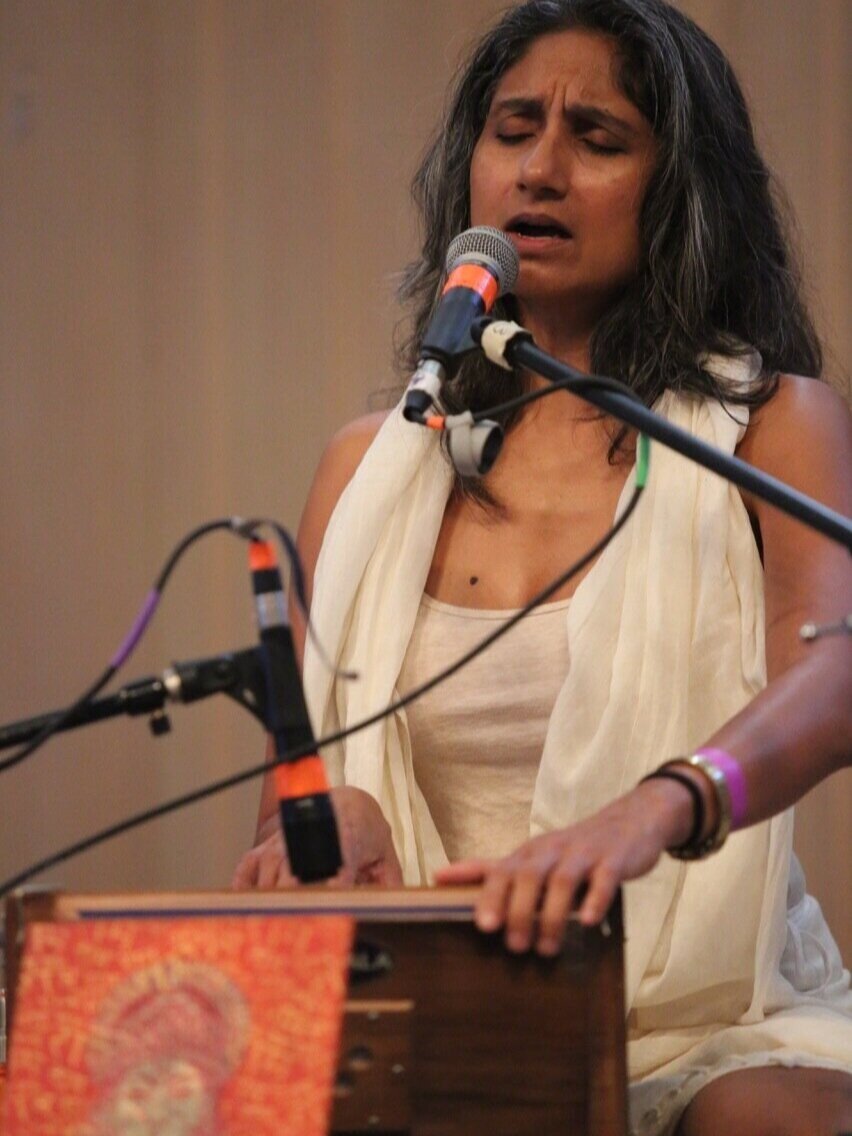
Nina Rao is a chantress, Nature and wilderness lover, mother of Uma and has released two chant albums (Antarayaami and Anubhav).
Invoking the Goddess with Nina Rao and Dr Joanna Kujawa

If you liked my interview with Krishna Das, you will love this one as well. Nina gives us tools to connect with the Feminine Aspects of the Divine and discusses the Hindu Goddess Tradition as well as her own experience of the Divine as both Feminine and Masculine. We also talk about restoring the balance between the Feminine and Masculine aspects in us and in the world. We invoke the Goddess of Wisdom and talk about spiritual practices such as invoking the names of the Goddess, the power of the name itself and the Energy that it brings into our lives.
Much love, Dr Joanna Kujawa


BHNN Guest Podcast – Ep. 65 – Nina Rao – Women’s Stories of Neem Karoli Baba with Mirabai Bush, Parvati Markus, & Radha Baum

Nina Rao hosts Satsang elders Mirabai Bush, Parvati Markus, and Radha Baum in sharing stories from the female perspective about Indian mystic and Guru, Neem Karoli Baba.

Joining together in a virtual remembrance and celebration of the life and teachings of Indian Guru, Neem Karoli Baba, on the anniversary of his Mahasamadhi, Nina invites powerful female Satsang elders Mirabai Bush, Parvati Markus, and Radha Baum to share stories of their time spent in his presence after following the path laid out by Ram Dass to India in the early 1970s. Illuminating the deep transmission of gathering in community and sharing stories of the Guru, Nina welcomes us all to meet where our rivers merge, joining in Satsang and darshan of the divine loving presence known affectionately as Maharajji.

The Path of the Guru: First Darshan

Prompted by Nina; Mirabai, Parvati, and Radha each share their unique and nuanced experience of finding the spiritual path, discovering Neem Karoli Baba, and journeying to India to have his darshan. Darshan is to be enveloped in the divine, reflective presence of a Holy being, an entity with the ability to help guide you to the place of Oneness inside yourself. Sharing their personal stories, Mirabai, Parvati, and Radha elucidate the deep, bellowing, gravitational pull of the Guru’s Grace.

“We piled into Ram Dass’ red VW bus and went to Kainchi, washed our fruit, took our shoes off, went into the temple, and met Maharajji. I had spent time with other ‘saints’ and always felt like something was wrong with me. I couldn’t open my heart. I couldn’t bow at their feet. It didn’t make any sense to me. As soon as I saw Maharajji, that was it. There was no question. There was no having to surrender. It just was.” – Parvati Markus

Getting a Name, Embodying an Essence (36:40)

Famously starting with Bhagavan Das and Ram Dass, Maharajji was known for giving Hindu holy names to the Western devotees who traveled to have his darshan in the early 1970s. Many of the devotees were versed in Indian culture and yearned for specific names, while other’s like Radha were a little skeptical and averse at first, but slowly learned to grow into and embody the essence of their given names from Maharajji.

“I love my Krishna, who is Maharajji, Shiva, Hanuman – I love him as whatever he is, which is everything. [Radha] was a good name for me because I just love him so much…I never, ever experienced anything like this. It’s the greatest love, more than any kind of love you could conceive of.” – Radha Baum

Transformation, Presence, & Lineage (56:52)

Highlighting the experience of spending months with Maharajji at his ashrams in India, the ensuing personal transformations that took place, and the lineage that was brought back to West in the form of Bhakti Yoga, the Hanuman Chalisa, satsang, kirtan, and service; Mirabai, Parvati, and Radha speak to the life-changing and metamorphic reality of sitting in Maharajji’s presence.

“The questions just fell away. They seemed irrelevant being with him. It was just his presence that was the teaching. It wasn’t reduced to a knowing about any particular thing. It was a wholly different way of knowing than before.” – Mirabai Bush

Be Here Now Network Podcast - Nina Rao - Women’s Stories of Neem Karoli Baba with Mirabai Bush, Parvati Markus, & Radha Baum

Nina Rao hosts Satsang elders Mirabai Bush, Parvati Markus, and Radha Baum in sharing stories from the female perspective about Indian mystic and Guru, Neem Karoli Baba.

Joining together in a virtual remembrance and celebration of the life and teachings of Indian Guru, Neem Karoli Baba, on the anniversary of his Mahasamadhi, Nina invites powerful female Satsang elders Mirabai Bush, Parvati Markus, and Radha Baum to share stories of their time spent in his presence after following the path laid out by Ram Dass to India in the early 1970s. Illuminating the deep transmission of gathering in community and sharing stories of the Guru, Nina welcomes us all to meet where our rivers merge, joining in Satsang and darshan of the divine loving presence known affectionately as Maharajji.

Sacred Music with Nina Rao - Podcast with Conscious Diva

How can the practice of Kirtan assist us with what’s happening in the world today - particularly with trauma. In this episode, renown kirtanwalli, Nina Rao explains the devotional music chanted in bhajans, kirtan and the practice of Bhakti, and how we become receptive to the flow of grace through chanting. Nina also shares the story of Hanuman from the Ramayana and how through the practice of Maha mantra, a transmission of wisdom is received by the practitioner.

LISTEN ON SPOTIFY
LISTEN ON iTUNES

Be Here Now Network Podcast – Nina Rao - Saving Wild Tigers with Dr. Ullas Karanth and Dr. Krithi Karanth

Nina Rao talks with tiger conservationists Dr. Ullas Karanth and Dr. Krithi Karanth about their work at the Centre for Wildlife Studies in India.

Dr. Ullas Karanth is the Managing Trustee and Director of the Centre for Wildlife Studies. His daughter, Dr. Krithi Karanth, is the Chief Conservation Scientist. They practice science-based conservation to promote the protection of wildlife. For over 20 years, Nina Rao’s Saving Wild Tigers has supported the Karanth’s work in creating viable sanctuaries for wild tigers.

Don’t miss Saving Wild Tigers online benefit concert: Sacred Music for Sacred Forests. Premiering at 7pm ET on May 30, join Nina and artists such as Trevor Hall, MC Yogi, and Krishna Das in their expression of love for nature.


BHNN Guest Podcast – Ep. 58 – Nina Rao – Saving Wild Tigers with Dr. Ullas Karanth and Dr. Krithi Karanth

Nina Rao talks with tiger conservationists Dr. Ullas Karanth and Dr. Krithi Karanth about their work at the Centre for Wildlife Studies in India.

Dr. Ullas Karanth is the Managing Trustee and Director of the Centre for Wildlife Studies. His daughter, Dr. Krithi Karanth, is the Chief Conservation Scientist. They practice science-based conservation to promote the protection of wildlife. For over 20 years, Nina Rao’s Saving Wild Tigers has supported the Karanth’s work in creating viable sanctuaries for wild tigers.

Obsessed with Tigers

Nina welcomes Ullas and Krithi, and asks both how they came to their love of tigers and wildlife. Ullas talks about his efforts to help restore the tiger population in India, and how there’s room to create more wilderness habitats for tigers around the globe. They discuss the importance of biodiversity, and the deep culture of tolerance for wildlife in India.

“In general, [humans] want nature. And I think it’s like priceless paintings that you have inherited. Why do you want to rip it up for a couple dollars?” –Dr. Ullas Karanth

Conservation Efforts (20:03)

Nina asks Krithi about the projects she has created for the Centre for Wildlife Studies, including one that looks at the scale of interaction between humans and wildlife in India. Nina and Ullas talk about the work he does in the field, and his program to train the next generation of conservationists.

“One thing that struck me was no matter where we went, and how many households we talked to, there was an acknowledgement that these spaces were to be shared with animals. Sometimes the animals cause problems, but inherently there is this recognition that these animals have been around as long, if not longer, than us.” – Dr. Krithi Karanth

Tigers and Covid (36:50)

Nina asks Ullas about the news of the tiger at the Bronx Zoo that was infected with Covid-19. They discuss how wildlife poaching in India has increased due to the pandemic lockdown. Krithi talks about the scope of another program she runs, and how everyone who works in the NGO sector is affected by the economic turmoil caused by the pandemic.

“A human being can pass on Covid to a tiger if he literally hugs and kisses it, which happens in zoos, but it’s highly unlikely to happen in the wild in India.” – Dr. Ullas Karanth

Be Here Now Podcast – Nina Rao - Preserving the Wealth of Nature with Robert Thurman

Robert Thurman joins Nina Rao for a conversation around strategies we can use to restore our balance with nature for the sake of our connection, Beauty, and global climate.

Robert Thurman is the Jey Tsong Khapa Professor of Indo-Tibetan Buddhist Studies in the Department of Religion at Columbia University, President of the Tibet House U.S., a non-profit organization dedicated to the preservation and promotion of Tibetan civilization, and President of the American Institute of Buddhist Studies, a non-profit affiliated with the Center for Buddhist Studies at Columbia University and dedicated to the publication of translations of important artistic and scientific treatises from the Tibetan Tengyur. Keep up with Robert at bobthurman.com

Find events near you featuring dharma talks, meditations and chanting with Nina at ninaraochant.com. Register here for the Sacred Music for Sacred Forests Benefit Concert with Nina, Krishna Das and Friends, NYC May 30, 2020. You can learn more about ways you can preserve the natural habitat of India’s tigers at Nina Rao’s wilderness conservation non-profit charity: savingwildtigers.org

Wisdom Rising: Mandala of the Five Wisdom Dakinis & Goddess Traditions of India and Tibet

Experience transformation through the power of chanting to the goddess in her many forms and through meditation on the maṇḍala—a universal map for inner and outer balance, wholeness, and practical awakening. Chandra and Nina share a deep interest in the complementary wisdom and devotional traditions of Tibet and India honoring the divine feminine. They will weave together mystical stories, visualizations, meditations, mantra repetition, and singing chants.


Read More

Interview with Phil Cartwright - Nina Rao "Anubhav" Album

ANUBHAV is the title of the album ~ Anubhav is a word Ma spoke when talking with Nina about how important it is to have a disciplined practice so it may blossom into each one’s own direct experience of the Divine, the Soul, the One. This inner knowing or perception or feeling, Anubhav, is what guides us on the Path of Life.
Nina Rao learned traditional chants (bhajans) from her grandfather in a village in south India when she nine years old. The chants quietly stayed with her until she rediscovered chanting with Krishna Das in New York in 1996. For many years Nina has been Krishna Das' business manager and assistant, often touring with him playing cymbals and singing. In 2007, she recorded the track 'Nina Chalisa' on Krishna Das' CD "Flow of Grace " and in January 2013, she released her debut album, "Antarayaami - Knower of All Hearts". Nina regularly leads kirtan, chanting of the Hanuman Chalisa, and sings for yoga classes in her hometown of Brooklyn, NY and beyond.

Positive Energy - Video Interview + Chant {with me and my Uma}

Here's an interview and chant (with Uma and me) - "Positive Energy" on Princeton Community TV that you might enjoy.

Exploring the Devotional Path with Nina Rao

Michele Granberg interviews well-known Kirtan artist Nina Rao, who travels the world with Krishna Das, about her spiritual journey. Nina and her daughter Uma share a beautiful sanskrit chant.

Embodied Love - Online Conference

Devotion is a phenomenon more universal than any particular tradition, for devotion can be as varied as love itself.  In the dharmic traditions, the term for devotion is bhakti. As Bhakti Yoga, it is a form of practice characterized by devotion to a deity. The more popular forms of bhakti are Vaishnava, Shaiva and Shakta in character (devoted to Krishna, Shiva, or forms of the Goddess, respectively). In all of these traditions, bhakti is both a form of religious and contemplative practice since love for a particular form of God/Goddess is widely accepted as one of the most effective ways to focus the mind.  

In this free online conference, we will discover both traditional and non-traditional forms of bhakti. We will explore the ways in which devotion transforms our world, from the inside out. Just as falling in love has the power to shape and renew one’s worldview, becoming a Bhakta transmutes our vision and refines our heart. Love for the divine further empowers the devotee to transcend aspects of mundane existence, as it challenges common and selfish expressions of love.  By dedicating our practice to a principle or deity that transcends the ephemeral, we can begin to taste the fullness of embodied love and its liberating possibilities.  

This conference, as with all programming at Embodied Philosophy, will seek to strike a balance between scholarship and practice. Each participant has been invited to share embodied bhakti-informed practices as well as scholarship and research relevant to Bhaktas and the various Bhakti traditions.

71197573_10156233517576854_7899682769997922304_o.jpg

We will learn about:

  • The history of Vaishnava Bhakti

  • The teachings of the Bhagavad Gītā

  • How to live the life of the heart

  • The yogic practices of devotion

  • The character of Hanuman, the personification of devotion from the Ramayana

  • How Bhakti yoga differs from other forms of yoga

  • Why serving the divine will save the world

  • The relationship between the Bhakta (or practitioner) and Bhakti

  • The relationship between the human and the divine in Vaishnava Bhakti

  • Stories from the Indian tradition that are central to Bhakti

  • Sri Krishna

  • The 9 Practices of Vaidhī Bhakti

I am so pleased to be included as a presenter in this free online event coming up Oct 4 to 6, 2019.

Sign up here!
https://www.embodiedphilosophy.org/a/17738/tSca2zU2


Mindrolling Podcast – Raghu Markus with Nina Rao on Nina's Anubhav CD

Nina Rao visits the Mindrolling Podcast for a chat with Raghu about the transformative power of mantra and the fruits of pursuing a spiritual path.

Nina learned traditional chants from her grandfather in a village in south India when she was nine years old. The chants quietly stayed with her until she rediscovered chanting with Krishna Das in New York in 1996. For many years Nina has been Krishna Das’ business manager and assistant, often touring with him playing kartals (cymbals) and singing. In January 2013, she released her debut album, Antarayaami – Knower of All Hearts and her sophomore album, Anubhav, in 2018. Nina regularly leads kirtan, chanting of the Hanuman Chalisa, and sings for yoga classes in her hometown of Brooklyn, NY and beyond. Keep up with Nina Rao at ninaraochant.com.